An intimate learning group for therapists & healers · Dojo Bianco, Tuscany
The Learning Group
Vitalizing The Way & The Work
Four practitioners. Four senior perspectives. Six days at Dojo Bianco. One year of continued inquiry.
The learning group
There comes a point when more training is not necessarily what is needed.
You may know your methods. You may have years of experience. And still, there are places in your work that are difficult to see from inside your own practice. The Learning Group begins there.
This is not a school and not a single methodology. Your own practice becomes the material: the people you cannot quite understand, the interventions you repeatedly make, the moments when you become certain, careful, responsible or unsure, and the practitioner you are becoming.
Seeing before certainty.
The work is not to arrive at the correct interpretation more quickly. It is to notice how we see, what shapes what we see, and what becomes visible when another experienced person looks from somewhere else.
What we explore
The Person in Front of You
What are you seeing? What are you assuming? What becomes invisible once you think you understand?
You in the Room
What happens in you while you work? Where does your attention go? What do you begin trying to make happen?
Your Way of Working
Which parts of your practice are genuinely yours? Where does technique support perception, and where might it begin to replace it?
The Unknown
Can you remain curious when you do not know? Can uncertainty become part of the work rather than something to resolve too quickly?
Personal Myth & Vitality
What brings you most alive in the work? What has become habitual, and what still carries curiosity, freedom and creative expression?
Vitalizing the Work
Moving beyond the wish to be correct or helpful toward a presence that is responsive, alive and capable of meeting another person fully.
Days at Dojo Bianco
Six days. One shared field.
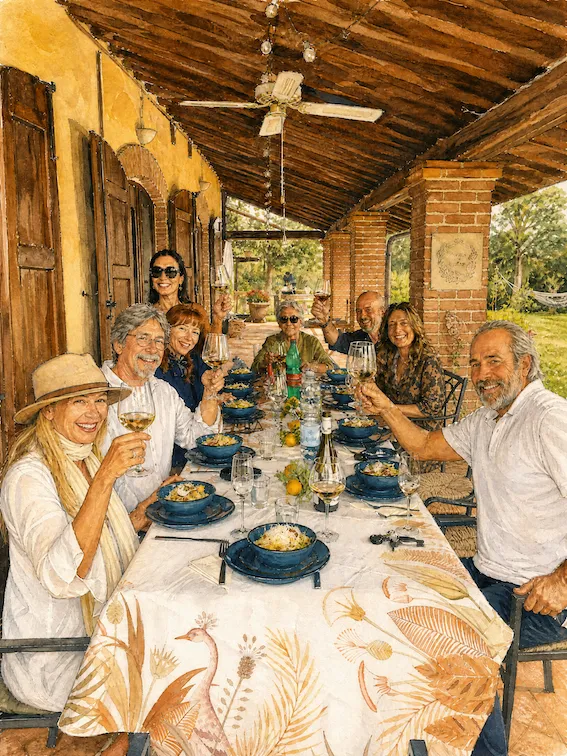
The work moves between cases, group inquiry, embodied practice, individual reflection, horses, walking, meals and ordinary time together. A question raised in the morning may return at lunch; something understood intellectually may look different in the body or in relationship. Dojo gives the inquiry time to move.
Small-group meditation & learningGroup process & discussionClient and practitioner reflectionHorse presence & natureEmbodiment practicesMeals & evening community
The setting
The place is part of the process.
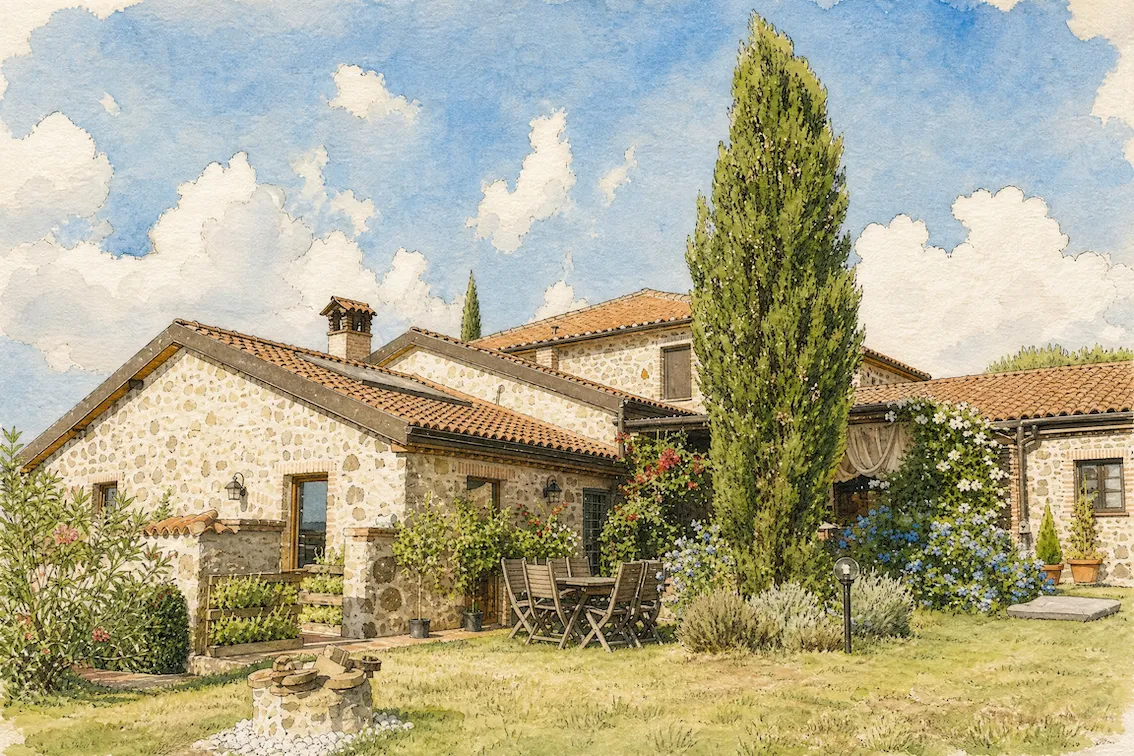
The group lives and works inside Dojo Bianco: the lodging, meals, fields, horses, quiet and beauty are not background scenery. They create the conditions in which work, play, rest and reflection can belong to the same experience.
Four senior perspectives
Michael Mervosh, Josef Beraha, Giulio Brunini and Dr. Ceren Akçelik Brunini bring distinct bodies of experience to the same work — depth psychology, relationship, breath, somatic awareness, neuroscience, perception, embodied practice and work with horses. Over six days, these perspectives meet around the work of just four practitioners.
“It is more important to me that my presence be felt as vital, rather than my interventions be correct.”
Michael Mervosh — Depth, relationship and the practitioner
Michael is a psychotherapist, teacher and group facilitator with decades of experience in clinical practice, experiential group work and the development of practitioners. His work reaches beneath technique into the psychological and relational life of the practitioner — protection, shadow, projection, vulnerability and the ways our own history enters the room. A central question in his work is not only what are you doing?, but who are you while you are doing it?
Josef Beraha — Breath, body and relationship
Josef works with breath, embodied awareness and relationship. His attention includes what is happening before experience becomes explanation: breathing, contact, distance, rhythm, energy and the movement between people. His work creates opportunities to experience directly what may otherwise remain conceptual.
Giulio Brunini — Somatic awareness, presence and horses
Giulio is a somatic practitioner and coach whose work centres on presence, embodied awareness and direct experience. He pays particular attention to what the body communicates before we have explained it — where we brace, withdraw, anticipate, push, lose contact or begin trying to produce an outcome. His work at Dojo also extends to the horses, where intention, boundaries, regulation, pressure and relationship can become immediately visible.
Dr. Ceren Akçelik Brunini — Neuroscience, perception and embodied pattern
Ceren is a neuroscientist, practitioner and former faculty member at the Barbara Brennan School of Healing. Her work brings neuroscience into dialogue with psychology, somatic and energetic practice, and years of direct work with people. She is particularly interested in perception: how previous experience shapes prediction, how prediction becomes embodied response, why insight alone does not necessarily create change, and what happens when practitioners begin examining not only what they see, but how they came to see it that way.
When the work leaves the room
Another way of observing relationship.
At Dojo, learning does not remain inside the consulting room. The horses are an important part of the Learning Group. The work takes place on the ground — not as riding, and not as a technique to learn — but as another way of observing relationship.
With a horse, professional language becomes less useful. Attention, hesitation, pressure, distance, boundaries, intention and regulation become tangible. What we believe we are communicating and what is actually happening in the encounter are not always the same.
The land, walking, meals and the ordinary spaces between structured work matter too. Six days together allow an inquiry to continue beyond the moment in which it first appeared.
Something noticed in a case can be encountered in the body. Something encountered with a horse can return to the consulting room. A conversation can continue at the table.
The 2027 Learning Group
A year that begins before Dojo.
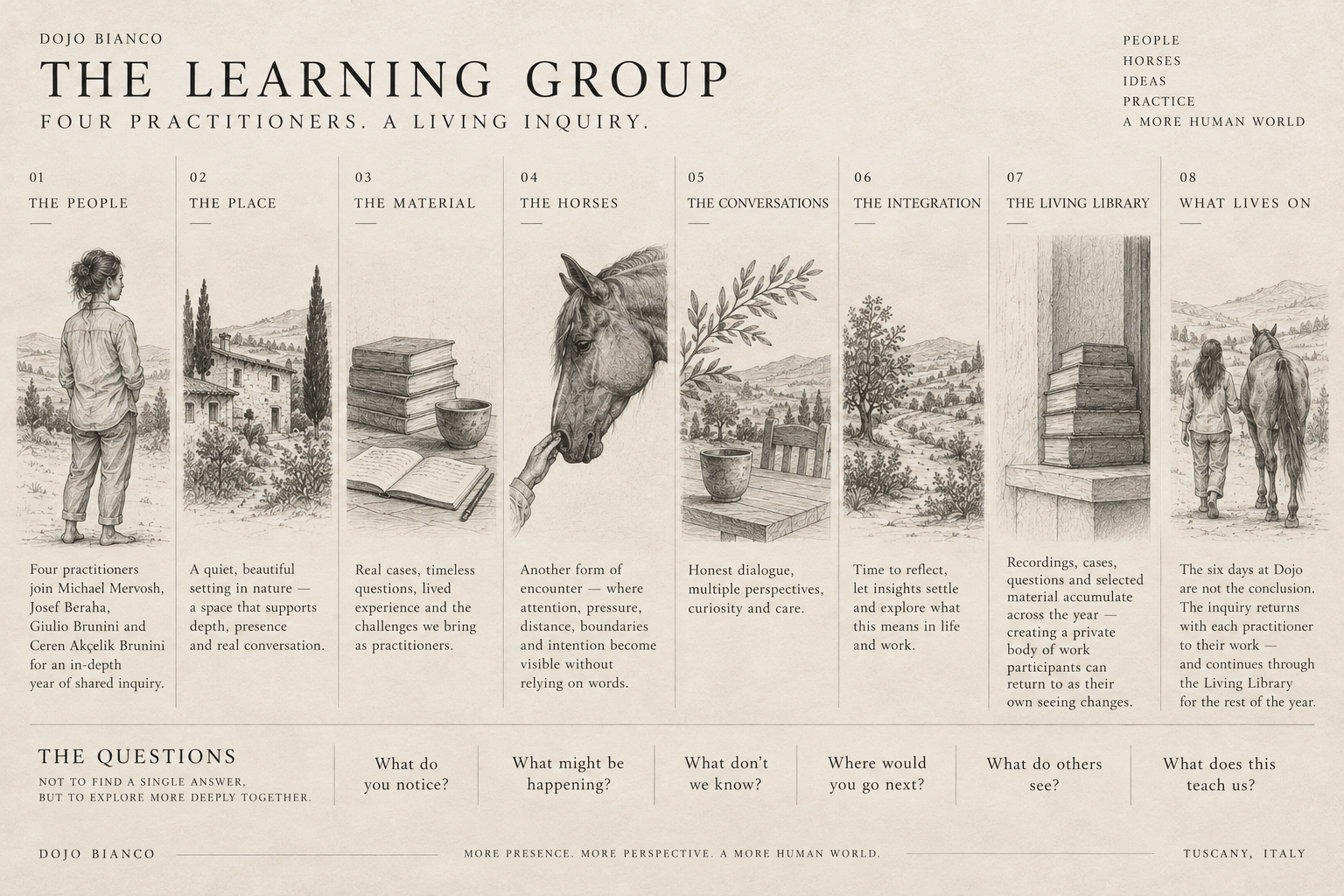
The group begins together on 10 April 2027, when the four practitioners enter the Living Library — their private digital home for the year. The six-day gathering at Dojo Bianco begins on 12 October 2027. The months between are not waiting time; they are part of the Learning Group.
The months before Tuscany are part of the work. Cases, recorded conversations, questions and selected teachings create a shared ground without turning the experience into another online course.
This is some text inside of a div block.
Not an archive of answers. A record of inquiry in motion.
From 10 April, each participant enters the Living Library: a private digital home for the Learning Group, open throughout the year. It begins with recordings from Michael, Josef, Giulio and Ceren, selected teaching, case material and questions prepared for this particular group. As the year unfolds, new material is added from the work itself — conversations, observations, cases and recordings from Dojo where appropriate.
The Living Library is not a course to complete or a collection of videos to consume. It is a working record that can be returned to. A case first seen in April may look different after six days at Dojo. A question can be heard again months later. Something noticed with a horse can return when the practitioner is back in the consulting room. The same material can reveal something new because the person looking at it has changed.
See first. Return. Compare. Notice what has changed.
Application
Four places, chosen around the group.
The Learning Group is for practitioners who already have a real relationship with the work: therapists, psychologists, coaches, somatic practitioners, healers and other professionals working closely with people. It is not necessary to have trained with Dojo before.
The application is deliberately personal. We ask about your practice, the questions that currently matter to you, where you find yourself repeatedly challenged, and what you hope to place under sustained inquiry during the year. Applications are followed by a conversation before invitations are made.
Request an application →One year of continued inquiry
From 10 April, the group has a private digital home and year-long access to the Archive & Library. The six days at Dojo in October are the centre of the year, not the end. Afterwards, cases, recordings, observations and earlier questions can be returned to and seen again from inside the practitioner’s real work.
Request an application →